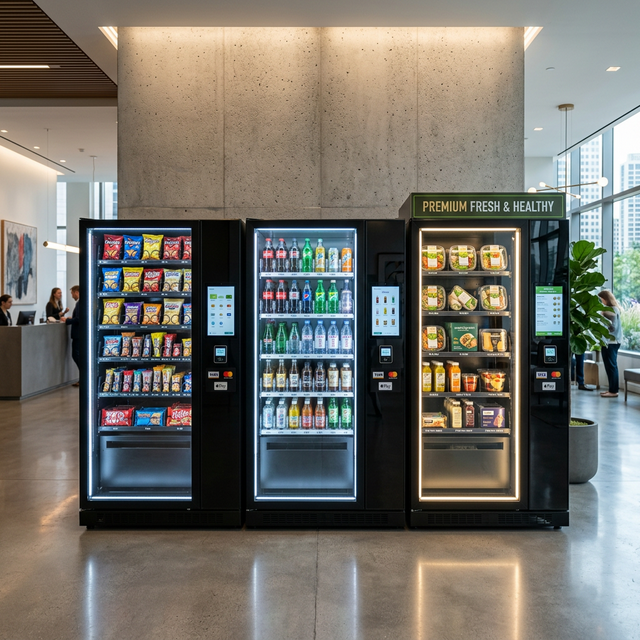
Start with the people who will actually use the break room
A useful refreshment program starts with a workday, rather than a machine catalog. In Miami-Dade County, an office with hybrid attendance, a warehouse with overnight shifts and a hotel with separate housekeeping and kitchen teams can all report the same total headcount. They may need very different service. Count the people on site during each shift, where they take breaks and whether they have time to leave the property for food. Include contractors or visitors only when they will actually have access to the equipment.
For one ordinary working week, note attendance, break periods and the busiest changeovers. Ask whether staff bring lunch, buy food nearby or need a dependable backup when meetings run long. An anonymous preference survey can help, but do not treat every requested product as a promised sale. Ask people to identify their everyday choices and their occasional treats separately. A practical initial assortment balances those preferences with the available machine slots or shelf space.
Distinguish scheduled employees from people present at one time. A business with a large payroll spread across several small buildings may have less concentrated demand than a smaller operation sharing one break room. A building manager should also distinguish tenant traffic from access to an employee-only area. Those details matter when evaluating a traditional vending placement or deciding whether a larger micro market is appropriate.
Record seasonal or recurring changes. Hospitality staffing, school calendars, special events and temporary projects can change demand without changing the permanent employee list. Share a normal operating pattern and any known busy period with the provider. This gives the service plan a realistic starting point and reduces the chance of choosing equipment around an unusually active week.
Compare vending, micro markets, coffee and pantry service
Traditional vending keeps products inside enclosed equipment. A snack machine, beverage machine or combination machine may suit a compact break room or an area with mixed access. Confirm the actual equipment dimensions, payment hardware, refrigerated capacity and ventilation requirements before choosing a position. A combination unit can save space, but its capacity may be a poor match for a busy shift change. The right choice depends on use, not on the appearance of the machine alone.
A micro market uses open shelves, coolers and a checkout point. It can accommodate a wider assortment, including packaged meal options when the equipment and operating plan support them. It also requires a deliberate approach to access, checkout instructions, inventory control and refrigeration. An employee-only room is different from a public lobby. Ask how purchases, refunds, missing inventory and outages will be handled before approving an open market.
Office coffee service addresses a different daily need. Consider the busiest brewing window, cleanup responsibilities, water supply and the preferred drink choices. A small office may prefer straightforward brewing; a larger operation may need several points of service. Equipment capability and available ingredients determine the actual menu. Ask who replenishes cups and supplies, who cleans the equipment and whether consumables are billed separately.
Water service can involve bottled products, coolers or filtered equipment. A filtered system needs a suitable connection and a maintenance plan. Bottled products require storage and replenishment. Select the format after reviewing the room, the expected use and the building's approval process. Neither option replaces the workplace's broader hydration planning or facilities responsibilities.
Pantry service is employer-funded. Employees may take included refreshments without paying at a machine, while the business pays for the agreed products and service. Set a budget, decide which items are included and establish how unusual consumption will be reviewed. A pantry can complement paid vending instead of replacing it: an employer might cover coffee and water while employees buy additional snacks or drinks.
What no-cost placement means—and what it does not cover
Some standard vending placements qualify for equipment and installation without a charge to the host. Eligibility depends on anticipated product sales, attendance, service access, route fit and the proposed equipment. It is a site assessment, not an automatic entitlement based on a particular employee number. A provider may recommend a smaller setup, an employer subsidy or a paid alternative when the expected demand cannot support the requested arrangement.
Separate the host's equipment arrangement from the cost of refreshments. In a paid vending or micro market program, users buy products. In an employer-funded pantry, the business pays for products and the stocking arrangement. Coffee supplies, water equipment, premium installations, renovations, electrical work and optional services can have separate charges. Ask for the actual quote and written terms rather than treating a general “free installation” phrase as an all-inclusive offer.
Before signing, clarify who owns the equipment, what routine maintenance covers, how damage is addressed and how either party can end the arrangement. Discuss removal access, notice requirements and any proposed minimum purchase or subsidy commitment. Also ask how product price changes are communicated. A clear agreement protects the host's budget and gives employees a more predictable experience without requiring an invented price list.
Keep the comparison practical. Review the full monthly responsibilities for each option, including supplies purchased by the employer, staff time spent replenishing items and any building work required. A program with no host equipment charge can still involve electricity and space. An employer-funded program can be useful when the company intentionally wants to cover employee refreshments. Compare the proposals against the business's actual goals.
Translate Miami-Dade location into service planning
Brickell and downtown office buildings
In a multi-tenant tower, start with building management approval and the complete delivery route. Ask about loading reservations, freight elevator dimensions, protective coverings, insurance documentation and permissible delivery hours. A machine may fit the break room while failing to fit an elevator turn. Establish who can authorize entry when the normal facilities contact is away. For hybrid offices, use typical daily attendance rather than the maximum desk count.
Describe whether the equipment is for one employer, several tenants or a shared amenity. Access and purchasing responsibilities change across those settings. A coffee point near meeting rooms may serve a different demand pattern from a market in the main employee lounge. Review the Brickell service-area page alongside the building's own rules, then include those rules in the quote request.
Doral, Medley and Hialeah industrial workplaces
Warehouse and production sites should map demand by shift. If several teams break at the same time, beverage capacity and the number of payment points may matter more than a broad assortment. Ask whether the proposed restocking visit can reach the equipment without entering active loading zones. Record gate instructions, vehicle parking, pedestrian routes and any escort process. Equipment should be placed in an approved indoor environment with suitable power and ventilation.
Provide the normal schedule and any peak workload period. A night team needs access after the daytime office closes; a stockroom door that is locked overnight can defeat an otherwise useful setup. Planning for Doral workplaces should also include the distance between departments. One centralized station may be simple to service but inconvenient for employees at the opposite end of a large site.
PortMiami and airport-area operations
Distinguish a nearby commercial workplace from a restricted facility. PortMiami's official credentials guidance explains that access requires appropriate credentials and that requirements depend on the role and access needed. A quote for a port-related workplace should identify the exact location, entry procedure and responsible site contact. Do not assume that a delivery driver can enter a secure area because the address is familiar.
Miami International Airport provides its own airport ID badging information. Confirm applicable requirements with the facility before promising delivery or maintenance access. An off-airport warehouse and an airside workplace have different access conditions. These references help a manager ask the right questions; they do not imply an existing relationship with the airport or port.
Miami Beach hospitality and coastal properties
For hotels and other hospitality workplaces, identify whether refreshments serve employees, guests or both. Staff-room demand may occur in several shorter windows around housekeeping, kitchen and front-desk shifts. Guest access can introduce different purchasing expectations and security needs. Ask the property team about loading, indoor placement, restricted corridors and seasonal occupancy. A staff amenity should remain reachable during the shifts it is intended to support.
Coastal sites should discuss the proposed room's actual conditions rather than assume all equipment is suitable outdoors. Salt exposure, heat, humidity and weather protection can affect placement decisions. Ask the provider and building manager to approve the environment for the specific equipment. Include a storm closure plan so a temporary property shutdown does not leave replenishment, perishable stock or reopening responsibilities unclear.
Coral Gables, Kendall and healthcare offices
Professional and healthcare workplaces often need a quiet, compact installation with controlled access. Keep employee refreshment areas distinct from clinical activities and patient-facing spaces unless the property has explicitly approved another arrangement. Ask about delivery timing, infection-control procedures set by the facility and who can admit a technician. For several small suites, determine whether a shared amenity is permitted before assuming the building's combined headcount supports one placement.
Prepare the room, delivery path and maintenance access
Measure more than the final footprint. Note door clearances, turns, thresholds, stairs, elevator capacity and the route from loading to the proposed location. Include photographs of the room and delivery path when appropriate, but avoid sharing sensitive access codes in an initial form. Ask the provider for dimensions and required service clearance for the actual equipment. Leave space for staff to queue, open refrigerator doors and reach neighboring fixtures.
A facilities professional should confirm power and any water connection. Avoid relying on an unapproved extension lead or a circuit shared with other demanding appliances. Refrigerated equipment needs the ventilation specified by its manufacturer. Keep exits and circulation paths clear, and review the layout with the property's accessibility process. Checkout controls, shelf reach and room access should work for the people who will use the service.
Agree on the provider's service route before launch. Who admits the technician? Where can the vehicle park? What happens if a planned delivery window changes? A named facilities contact and a backup are more useful than a generic instruction to call reception. Document how urgent equipment problems are reported and what information staff should include, such as the equipment identifier and a description of the issue.
Plan for temporary closures as well as ordinary operation. Miami-Dade County's business hurricane preparedness guidance emphasizes business preparation and employee communication. Apply that planning to the refreshment program by agreeing on closure notifications, access restrictions and reopening checks. Refrigerated food decisions after a power interruption belong with the responsible operator's food-safety procedures, not an improvised assumption that products are still suitable.
Build an assortment people can use
Start with a manageable selection of familiar snacks, water, other beverages and filling options that suit the actual equipment. Ask employees about dietary preferences without collecting health records. Product packaging remains the source for ingredient and allergen information. Do not promise that an entire machine or open market is allergen-free simply because it includes a few alternative products. Discuss how substitutions will be handled when a requested item is unavailable.
For multilingual teams, keep checkout instructions short and easy to follow; ask what languages would make the station more usable. Use clear price labels and a visible issue-reporting process. Confirm payment methods on the proposed hardware rather than assuming every unit accepts cash, cards and contactless payments. Review how a failed vend, duplicate charge or kiosk outage is resolved and what staff should do when assistance is needed.
For fresh or refrigerated items, ask about suitable storage, inventory rotation and monitoring. The broader selection of a micro market is useful only when replenishment and handling support it. Start cautiously if demand is uncertain. A smaller selection that turns over consistently can be more useful than a large display with products that staff rarely purchase. Review popular products and repeat stockouts after launch.
Do not treat vending as the whole employee wellness program. It can offer convenient choices alongside other workplace support. Make water easy to find, include alternatives to high-sugar drinks when requested and allow room for staff feedback. For coffee service, identify the supplies included in the agreement and where used cups, grounds or other waste will go. Assign daily tasks clearly so the station remains usable between visits.
Launch with a simple review plan
Before installation, confirm the approved location, access arrangements, equipment mix and written responsibilities. Share a brief employee announcement explaining payment, included employer-funded items and how to report a problem. Identify one facilities owner for the program. Multiple informal requests from different departments can make it harder to distinguish a recurring need from a one-time preference.
Review the first ordinary operating period with the provider. Look at the items that sell, empty slots, requested substitutions and any queue or access problems. Compare daytime and evening experience when the site has several shifts. Use the findings to adjust capacity, assortment or service cadence. A program should be allowed to settle before expanding solely because the first installation attracted curiosity.
Keep a short issue log rather than collecting unnecessary personal data. Note the date, equipment, product and resolution for repeated problems. Review how refunds are requested and whether instructions are visible. If workplace attendance changes substantially, revisit the plan. A new shift, tenant move or remote-work policy can alter demand enough to make the original equipment mix less suitable.
Send a quote request that supports a useful recommendation
Include the business name, Miami-Dade location, normal on-site attendance, shifts and preferred service. Describe the proposed room, whether access is employee-only and any known loading or security restrictions. Add the target timing and whether refreshments will be purchased by employees, funded by the employer or handled through a combination. These details help separate a viable standard placement from a custom project.
- Site location and a facilities contact with a working email.
- Typical attendance per shift, operating days and seasonal changes.
- Vending, micro market, coffee, water or pantry priorities.
- Available room, power, delivery route and approval requirements.
- Desired product choices and payment methods to confirm.
- Budget responsibilities, eligibility questions and target start date.
You do not need a finished specification to begin. A few accurate operational details are enough to start a conversation about suitable options. Review the service overview and Miami-Dade service areas, then request a free quote. Equipment availability, no-cost placement eligibility, optional charges and timing should be confirmed for your property before committing to a plan.
Local references checked October 5, 2026. This guide offers workplace planning considerations; each property's access, facilities and operating requirements must be confirmed for the proposed installation.